In memory of Nooran, for the protection of racialized youth
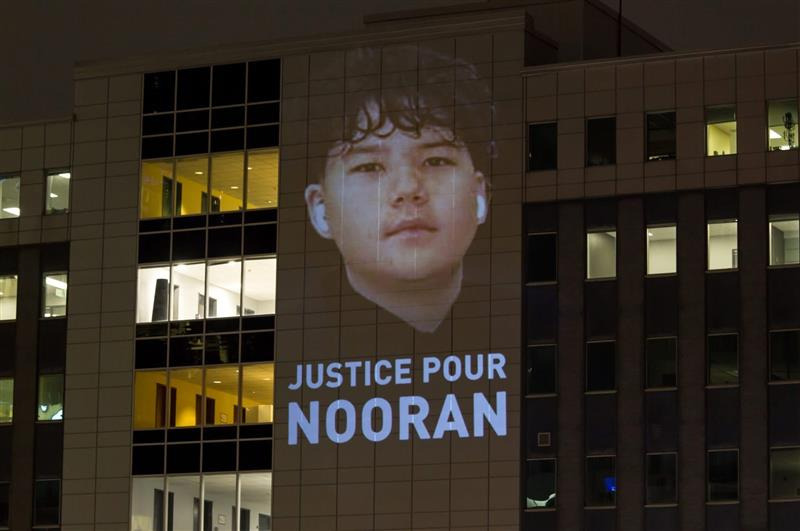
We cannot present our demands regarding profiling without acknowledging the tragic death of young Nooran Rezayi, a 15 year-old who was fatally shot by a police officer of the Service de police de l’agglomoration de Longeuil (SPAL) in Saint-Hubert borough on September 21.
Nooran’s death is not an isolated incident, but rather the expression of a system that has historically engaged in the profiling, exclusion and brutalization of BIPOC youth. His death, which reveberated across Quebec reopened the wounds of another tragic killing of Fredy Villanueva, who was fatally shot by police officer Jean-Loup Lapointe in August 2008 during an abusive police intervention in Montreal-Nord. This event gave rise to widespread movement of public protests, followed by a public coroner’s public inquiry. Despite repeated commitments made by both municipal and provincial authorities, no criminal charges were brought against the officer who killed Fredy. In March of this year, SPVM officers killed Abisay Cruz, a young father of a 9 years old child, during a police intervention at his home in Saint-Michel, acting with impunity despite that he was experiencing a crisis.
From this perspective, we can observe the dynamics : the deaths of the BIPOC youth are the direct result of systemic racial profiling and more broadly, racism. Indeed, it was a 911 call that led officers to stop and profile a group a young teenagers including Nooran. Although this latest tragedy occurred in Longueuil, it could very well have taken place in Montréal, since the Service de police de la Ville de Montréal (SPVM) continues to refuse to ban police stops. Despite repeated calls from several human rights organizations, including TGFM, to abolish police street checks, the SPVM has refused to impose a moratorium on them and stubbornly continues to legitimize these practices, including through their policy reform last May. This ‘reform’ does not aim to eliminate the arbitrariness of police street checks but rather obliges officers to 'inform the person being stopped, at the outset of the intervention, of the reason for the stop and the fact that they are free to leave.' While this new measure may reduce the number of stops, it does nothing to address racial and social profiling. In light of this policy, in Montreal, would a youth like Nooran have had the opportunity to ask if they were free to leave without being targeted by gunfire?
In addition to permanently banning random street checks, which are all too often carried out due to racist biases, other measures can be implemented to prevent such tragedies. As is already the case in other societies, police officers do not need to carry firearms in every situation. In the case of young Nooran, would he have been targeted by gunfire if the officers had not been armed?
In 2016, the Bureau des enquêtes indépendantes (BEI) was created in order to put an end to the old investigative practices, i.e 'police investigations of the police', in cases of abuse and police killings. It is now this 'specialized police force' that is responsible for investigating such incidents. Unfortunately, after 10 years of operation, the findings remain troubling: the BEI is not independent of the police, it reinforces police impunity, and it lacks 'critical transparency and impartiality' (Ligue des droits et libertés – LDL). Indeed, since its creation, the BEI has conducted 477 independent investigations, of which only 2 have led to judicial proceedings, representing just 0.43% of the investigations. However, to date, none of these charges have resulted in a conviction for the killing of an individual by the police (LDL). Following the deaths of Abisay and Nooran, public mistrust towards this institution has resurfaced, prompting a reexamination of the mechanisms in place to protect against police misconduct.
In conclusion, the death of young Nooran undoubtedly echoes the demands concerning profiling and the right to the city, as advocated by TGFM. We wish to express our full solidarity with his family, friends, and community. In our view, a society that tolerates child violence is a society that fails to protect its youth. As an intersectional feminist organization, it is essential to denounce police impunity and to protect young people, especially BIPOC youth, from structural violence. It is unacceptable to continue sending the message that these youth cannot live freely and collectively, at the risk of being systematically profiled, injured, or even killed. And because police violence does not only affect those directly victimized, it also impacts mothers, sisters, and grandmothers, who bear the grief, suffering and burden.
Currently, Nooran’s family continues to demand justice in a precarious context, where they receive no financial support, unlike the families of victims of criminal acts. Financial support for them can be made through this fundraising campaign : https://www.gofundme.com/f/justice-pour-nooran-rezayi
Nooran's story must not be forgotten, and today we wish to honor his memory.